
The Neretva River: Battle of the Wounded and Mostar
On our route south to Mostar, we stopped at Jablanica to visit the memorial complex honouring the Battle on the Neretva, which took place on January 20th, 1943. Known as The Battle of the Wounded, the heavily out-numbered partisan army retreated carrying 4,000 injured soldiers. Their withdrawal was from the predominately German and Italian Axis forces in the region encompassing present-day Bosnia-Herzegovina and northern Croatia.
Josip Boz Tito, the supreme commander of the Yugoslav Partisans, had a change of heart. Instead of launching an attack, he sought to save the wounded and sick soldiers. He devised a clever strategy to mislead the Axis forces, ordering the destruction of all bridges along the Neretva River. This cunning move deceived the Axis forces into thinking Tito was leading his army north. As a result, the Germans changed direction and headed towards the north, falling into Tito’s decoy trap.

The Bridge on the Neretva

The following morning after the assault, Tito dispatched a small team to construct a temporary bridge, just big enough for his forces to return to their original position on the river. Afterwards, he ordered the bridge’s destruction before leading his troops south.
That night, we stayed in the car park by the local football ground. There were a few comings and goings until midnight, but we were left undisturbed. The early morning prayer call helped us be up bright and early.
We’d been in Bosnia and Herzegovina for just over three weeks, and during this time, we had met very few people, let alone tourists. We anticipated a surge in activity as we approached Mostar but were unprepared for the sheer number of tourist-filled coaches. They pulled into laybys to snap instaworthy shots of the Neretva River’s crystal-clear water, framed by towering rocky canyon walls.
Our first night in Mostar was on the outskirts at the Millenium Cross. You can’t fail to notice the enormous memorial cross standing 100 feet high on Hum Hill. The cross has created some division around its religious and cultural dominance over a city with a bloody and sad history.

Millennium Cross, Mostar

The Hill has a reputation for being a lovers’ spot, particularly after sunset. We were fortunate and were alone. Some of you may have read reports about piles of litter further up the track. However, if you park before the cross, you can easily avoid it and admire the surroundings. We enjoyed a quiet and peaceful night in May 2023.
The next day, we drove across the valley to the hills on the other side of the city. From the dizzy heights of the Fortica Skywalk, we marvelled at the breathtaking views and panoramic vista. Built 15 metres above the slopes of Fortica Hill, the glass walkway stretches to 35 metres. There’s also a zip line for those seeking an extra dose of adrenaline.

Fortica Skywalk
We’d heard that the Merdzan Glava Fortress, an Austrian-Hungarian fortress constructed around 1888, offers a breathtaking vantage point across Mostar and the Neretva River. However, the last part of the track was only suitable for 4x4s or motorbikes. Despite a few attempts by cars, they were unsuccessful. We had a tranquil night.

Merdzan Glava Fortress


The following day, we relocated below the fort, where there was more grass, which was much gentler on Twiggy’s arthritic paws. Over the next few days, we experienced a similar weather pattern: glorious mornings, terrific thunderstorms and heavy downpours in the afternoons, followed by calm evenings, perfect for winding down.
If you’ve been following, you may remember me mentioning that the portable solar panel stopped functioning after the last dramatic thunderstorms with the wild horses at Livno. The power pack found the intensity too much on this occasion and died.
We can’t complain too much. Both were cheap versions to trial and lasted around two years. However, the 240v gave up within six months. At least it chose to wait until sunnier times arrived before failing.
One night, we had a personal protector. A shepherd’s dog resembling a lion took on the duty of keeping watch watch. Peering out the window, a huge grin displaying pearly white teeth greeted us. Clearly exhausted from a day’s sheep guarding, he decided he was too weary and needed to rest. Fortunately, at a distance so that, we could take our two out. Rolo wisely had the sense to remain silent, realising he was no match for this big boy.
We trundled down the mountain late Sunday afternoon to Mostar and Hotel Verso. For 10 euros, the hotel welcomed overnight campers. With its security cameras, barriers, and a small toilet block in the car park, we felt comfortable leaving Wolf while exploring the city.

Wolf checked in at the hotel

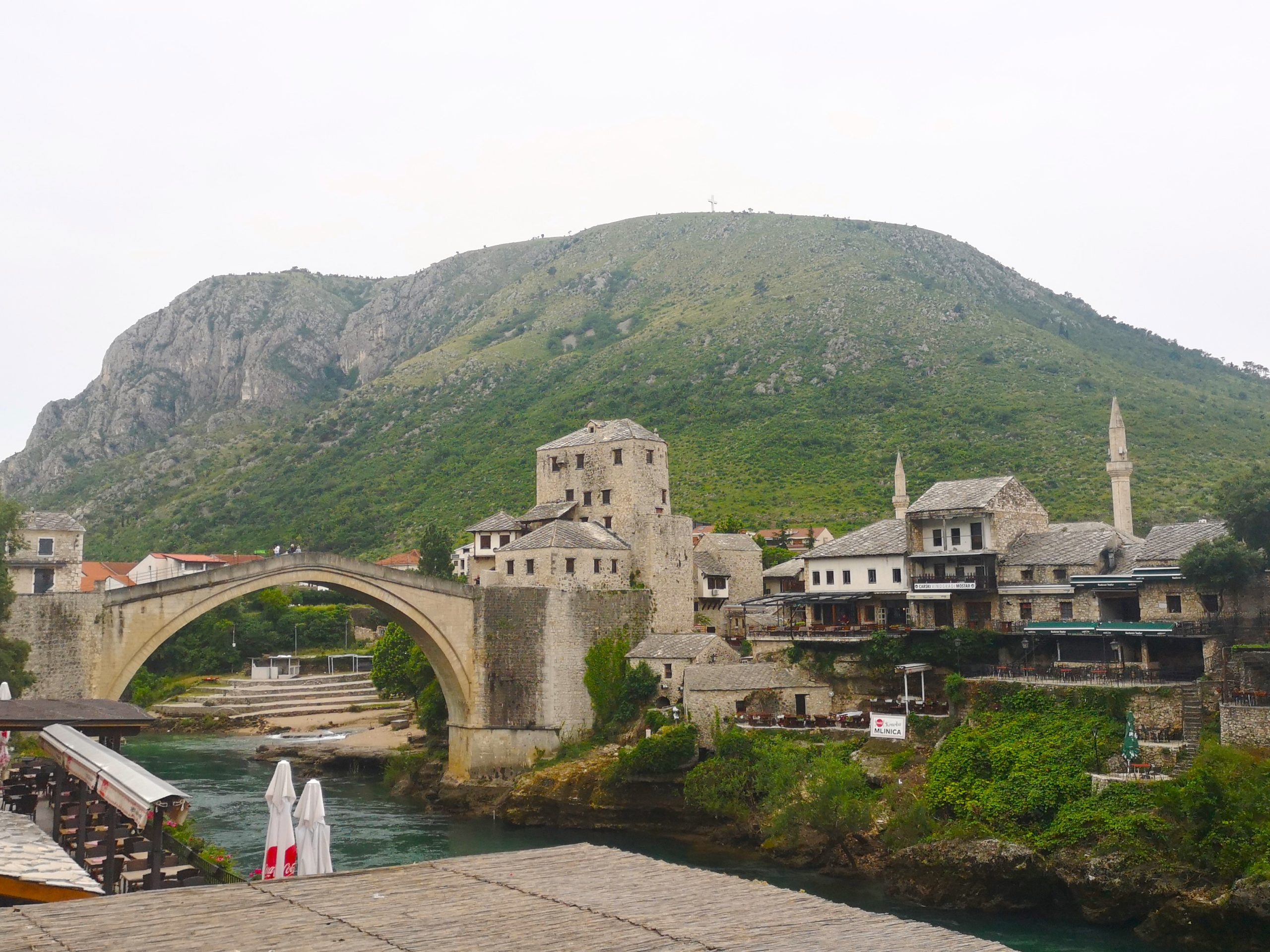
Looking across from the Old Bridge

Stari Most, also known as Mostar Old Bridge
As the daytime temperatures cooled, we ventured out to explore the old town and its iconic bridge, Stari Most. It didn’t take long to realise this was a mistake. Crowds of people filled the narrow, cobbled streets, making us worry about heavy feet trampling on little paws. The deciding moment came when Twiggy mustered all her self-control when a child waved an ice cream at perfect mouth height.
The New Town seemed a better option, with its peaceful atmosphere. We strolled past memorials and parks to a roundabout, where a striking orange and yellow school, Mostar Gimnazija, built under Austro-Hungarian rule, was significantly damaged during the Bosnian War. Although not a tourist attraction, the building is impressive in its architectural style.

A cobbled street of the Old Town

The notorious slippery cobbles of Mostar Old Bridge

Halebija Tower

One of many war-damaged buildings

Mostar Gimnazija, two secondary schools under one roof
0 Comments