
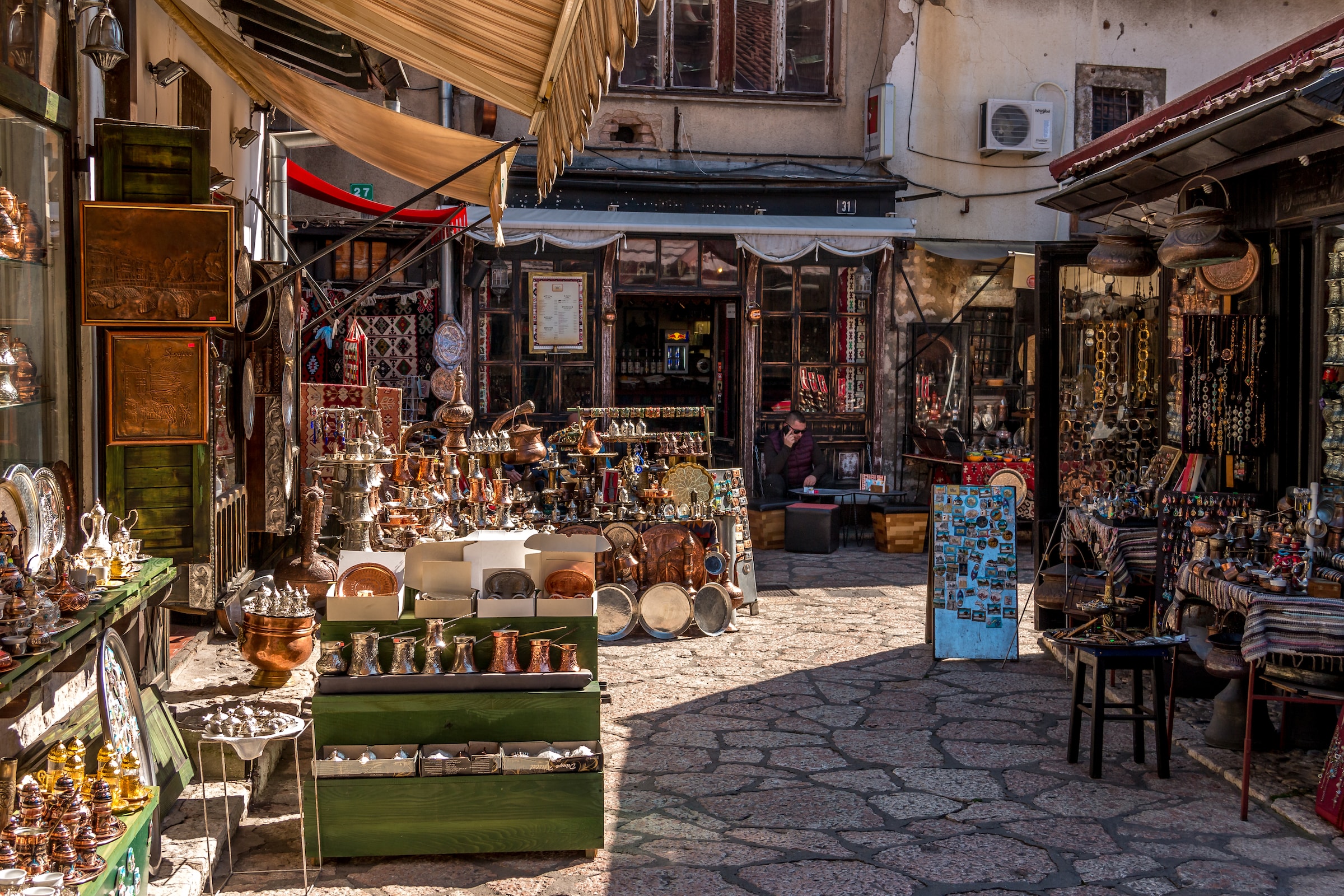
Photo by Peter Schulz
Life on the Road, Always a School Day: A Trip to Sarajevo and East Bosnia & Herzegovina
As we left the historic town of Mostar, the eerie depths of Mostar Aircraft Hangar beckoned. Once a top-secret facility used to house fighter jets during the Yugoslavia era. The abandoned hangar in the small village, Gnojnice, 7.5 km from Mostar, is strategically positioned opposite the airport. The warplanes were hidden from prying eyes, ready for deployment at a moment’s notice.
The open gates enticed us down the driveway, even though we felt we were trespassing. At the large archway leading into the mountain, a faint light lured us forward, where a man surrounded by banana crates said, without hesitation, to enter the hangar tunnel.

Wolf outside Mostar Aircraft Hangar
Dark and empty, bar some rubbish, neither Wolf’s headlamps nor the camera’s flash provided enough light to capture the cavernous space. Something is compelling about once-secret Cold War installations that makes them intriguing and draws us to investigate.
After the hustle and bustle of Mostar, we found a lakeside hideaway with plenty of space for the guys to stretch their legs. A few local fishermen turned up and were thrilled to share their region’s treasures.

Peaceful lakeside hideaway

Twig chilling in her lakeside garden
Our next stop was the Pješčane piramide, also known as the Sand Pyramids, nine kilometres from the small town of Foča, Bosnia. The road to the natural landmark had suffered from the recent heavy rain and was a bit ropey. However, it didn’t stop locals in their trusty 40-year VW Golfs.
A foggy start the following morning added a mystical feel to the environment. The natural pillars are a geographical phenomenon that has evolved for over 200 years. As frost, wind, rain, and summer heat erode the soil, towering sculptures rise from the earth, some reaching 20 metres high, and they will continue to morph as nature works her magic.

Pješčane piramide, the Sand Pyramids


Next was an Airbnb in Pale, about 17 km from Sarajevo, Bosnia and Herzegovina’s capital. The cute wooden chalet is ideal for a winter holiday, close to the ski slopes. For us, it was an out-of-season bargain, cheaper than a campsite, and including a washing machine.
The plan was to carry out some maintenance on Wolf, catch up with laundry, and take a couple of days to explore the capital city. Oh, and relax on the balcony, admiring the glorious views across Pale and the surrounding countryside. However, the rain interrupted play and changed our schedule. Instead, we made the most of unlimited Netflix, binge-watching for a few days.
Before leaving the area, we did a drive-by of Sarajevo. Although the rain hindered our Sarajevo stay, I wanted to see a few particular sights. As it was raining and we didn’t explore Sarajevo on foot, I’m afraid there are no photos.

A brief glimpse of the Airbnb view

Photo by Fatma Gül: Sebilj Fountain, Sarajevo

Photo by papatyayameftun: Sarajevo City Hall
A walk to the Olympic Bobsleigh and Luge Track was on our to-see list. However, we decided leaving Wolf was not worth the risk after driving into the car park and, unfortunately, noticing at least four parking spaces with broken car window glass and park-up reviews mentioning break-ins.
Our final destination in Sarajevo was a drive through the mountains, where some of the Ski events for the 1984 Sarajevo Winter Olympics took place. Much construction work was in process, including what seemed like new hotels and apartment blocks. With regional investment and Airbnb owners saying bookings were high, the area is emerging as an exciting future holiday destination.
We stayed a few nights at the bottom of a ski slope. The guys love pottering around their ever-changing big back garden, and for Twiggy, her highlight was the numerous streams running down the hillside, bubbling from natural underground springs.
Our only visitors were a few horses and a couple of workers interested in Wolf. They asked how long we were staying and were more than happy for us to stay.

Sarajevo 1984 Winter Olympic Rings

Some of our visitors

Wolf resting at the bottom of Sarajevo ski slopes
As we headed east to our next country, we could not leave Bosnia without visiting the Srebrenica Memorial Centre. Some of you may remember hearing the horrific news in July 1995 when around 8,000, mostly Muslim men and boys, were massacred over 72 hours.
The Memorial Centre is in the small village of Potočari, on a site chosen by survivors and bereaved families. The Memorial is opposite the United Nations Headquarters, a UN-declared safe zone, where many victims sought refuge only to be handed over by ill-equipped Dutch soldiers to Bosnian Serb troops.
Rows of white obelisk headstones fill the cemetery. It is a heart-wrenching, sobering place where bodies continue to be found and buried. Many shy away from acknowledging such atrocities, but in light of the world’s current turmoil, it is crucial to remember these tragedies. We must reflect and try to understand to avoid repeating these senseless and brutal acts.
Two days before writing this, Bosnia police arrested five more ex-Serbian troops suspected of being involved in the 1995 Srebrenica Genocide.

Srebenica Memorial Centre

We left the Memorial, struggling to get our heads around the number of deaths. We headed towards Višegrad, known for its historical Ottoman bridge, made famous by the book The Bridge Over the Drina, which won the author Ivo Andrić a Nobel Prize. The novel provides an understanding of the small, once multicultural community centred around the bridge from the Ottoman era to the outbreak of World War I.
As I had read the book, I wanted to see the town and bridge, a recognised UNESCO World Heritage Site with a long and dramatic history. I knew the River Drina lies on a popular rafting route, attracting thrill seekers on water adventures surrounded by breathtaking scenery and crystal clear waters.
However, I was unaware that Višegrad suffered immensely during the Bosnian War. Before 1992, two-thirds of Višegrad residents were Bosnian Muslims. Thousands fled, and many died, their bodies thrown into the river from the celebrated bridge at the hands of Bosnian Serbs. Very few have returned.

While this might seem a depressing end to our Bosnian travels, the past is harrowing, and the scars are visible. We leave Bosnia & Herzegovina with many thought-provoking memories and incredible experiences. Friendly people eager to share beautiful places to visit. The scenery is stunning. Spectacular landscapes, craggy mountains, dense forests, and crystal-clear rivers surrounded us.
Bosnia & Herzegovina was the first country we took Wolf off-road. We had oodles of fun and found fantastic places to stay. We could have happily stayed longer, and one day, we will return. However, next week takes us to another new and beautiful country, Serbia.
0 Comments