
Healing Water and Monuments
After leaving the Skumsale Thracian Megalith Site, our priority was water, which we swiftly found, as it has been readily available in the three Balkan countries we have visited.
While filling up at a village tap, two passersby stopped and pointed at the water and further along the road. We couldn’t grasp what they were saying, and trusty Google Translate was not to hand. They didn’t seem to mind us filling up, so with lots of smiles, we continued, and they went on their way.
When a local resident arrived, who had excellent English after living in Canada for 20 years, we finally understood what the previous villagers were trying to tell us. We were filling up with city water. Instead, a natural spring with healing water was a few kilometres further along the road.
The natural spring attracts visitors far and wide to experience the benefits of the water’s healing properties.

Healing water at Strelcha, Bulgaria

On the first appearance, the spring looks like any other place to fill up containers, but on closer inspection, there is a strong smell of sulphur, and the water is around an incredible 35 – 37°C.
We were fortunate to meet a local cleaning the area, who passed on additional information about the water’s healing powers to treat ailments such as eczema, arthritis, cardiovascular and respiratory. He demonstrated the water’s ability to cleanse by washing and eating weeds. We hoped he wouldn’t ask us to try some, as a few dogs roamed the area.
We filled a flask for drinking and the shower tank. We can’t confirm the healing powers, as neither of us had any sickness or injuries. However, the odour of rotten eggs lingered when showering and when we drank the cooled water from the flask. Thankfully, there was a lack of eggy flavour. Despite its smooth texture, we struggled to drink more than a sip, using the remainder for washing up.
Our next stop was the Borimechkata Monument. The impressive statue rises above the small town of Kilsura. The memorial remembers Ivan Tankov, a hero of the April Uprising of 1876 when Bulgarians rebelled against the Ottoman Empire’s rule.

Borimechkata Monument

Kilsura suffered greatly, burnt to the ground, outnumbered, and out-weaponed. They lost one of the highest death tolls during the uprising, and each year since 1896, the town has commemorated the events when citizens sacrificed their lives.
Ivan Tankov earned the nickname ‘ Borimechkata’, meaning ‘bear fighter’, and his heroism is celebrated in the novel ‘Under the Yolk’ by Ivan Vazov.
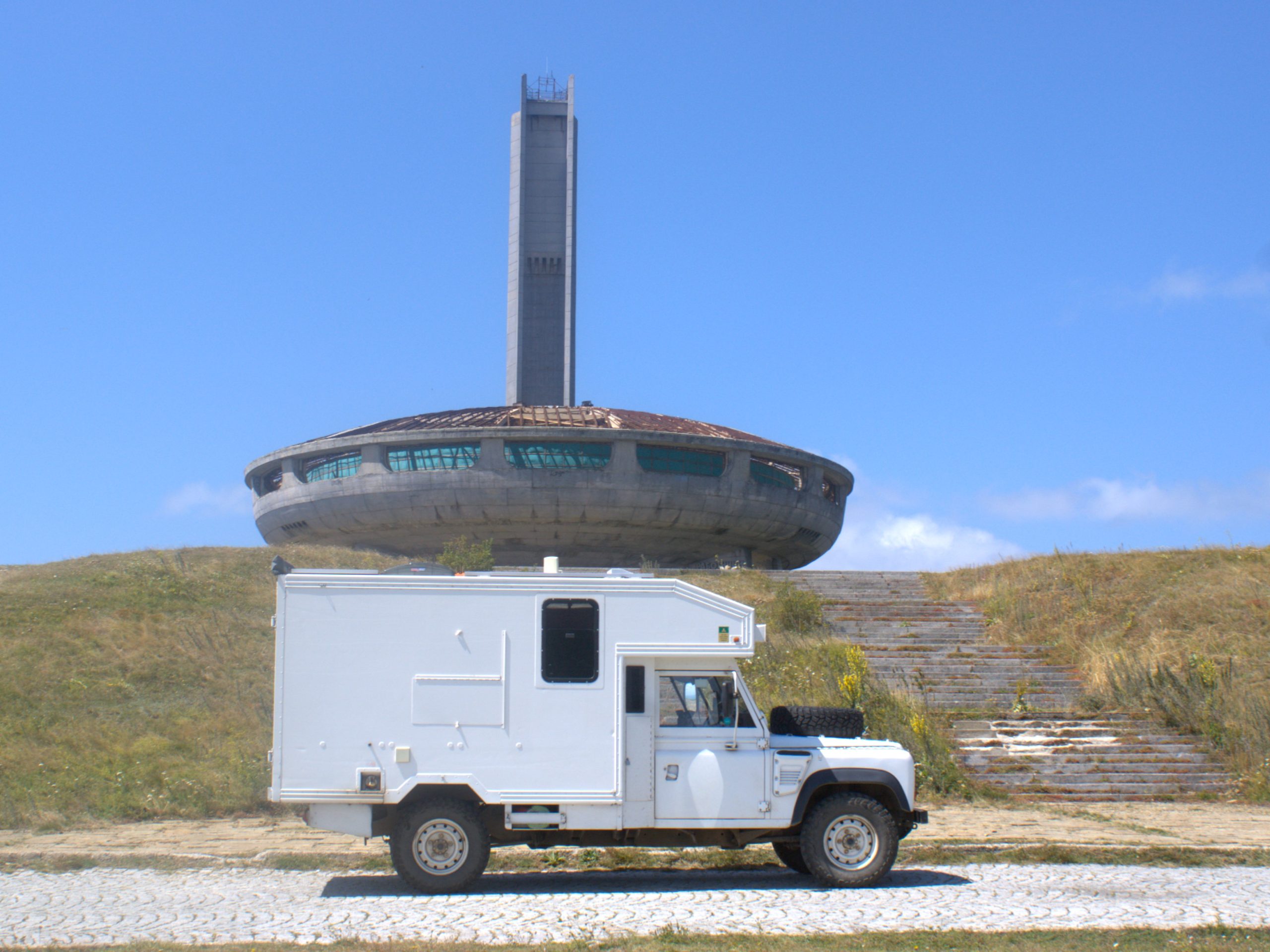
Our last stop in Bulgaria was the abandoned Buzludzha monument. High on a remote mountain peak, the Buzludzha Monument stands just over 1,400 feet above sea level. The UFO-like structure looks straight out of an old sci-fi movie. It served as the Monument House of the Bulgarian Communist Party, with its flashy red stars on the adjoining tower symbolising the Communist era.

Monument House of the Bulgarian Communist Party

The mountain Buzludzha sits atop is significant to Bulgarian history, having been a battle site between Bulgarians and Turks in 1868. Similar to Kilsura, the outnumbered Bulgarian forces suffered huge losses.
Construction of the monument took between 1971 and 1981, involving over 6,000 workers, including volunteers and soldiers. New roads enabled the removal of 15,000 cubic metres of rock and the transporting of new building materials, such as 40 tonnes of glass, 3,000 tonnes of steel, and 70,000 tonnes of concrete.
Once completed, the tower measures 70m (230ft) high, 9m (30ft) across at its base, and 16m (52ft) across at the highest point.

Buzludzha Monument built on Buzludzha Peak

A once dominant symbol of the Bulgarian Communist era now lies in an abandoned, pitiful state of repair. It has become a playground for off-roaders, graffiti artists, and vandals, who have robbed its cobalt glass that once glittered as extravagant mosaics. The red stars, believed to be made from ruby, became a marksman’s target. The windows are bereft of glass, leaving the derelict building vulnerable to the elements, snow, strong winds, and temperatures as low as -25°C.
There is hope for the monument, as its ruins are becoming world-famous. In March 2018, Europa Nostra acknowledged Buzludzha as one of the seven most endangered European heritage sites. In 2019, The Getty Foundation in Los Angeles awarded a grant to create a preservation plan for the structure. Bulgaria’s Ministry of Culture is considering official monument status, which would allow preservation work to go ahead.
We delayed our visit by a few days as a festival was taking place to promote the preservation of the symbolic monument.


Our stay in Bulgaria was short, only about two weeks. Unfortunately, the soaring temperatures were proving too hot for our elderly pooches. While we had been successful in mountain hopping in Serbia, it was proving more challenging in Bulgaria, with much of the country flat as we neared Romania. We had decided to up our speed and head north to seek cooler temperatures.


0 Comments